
Overview
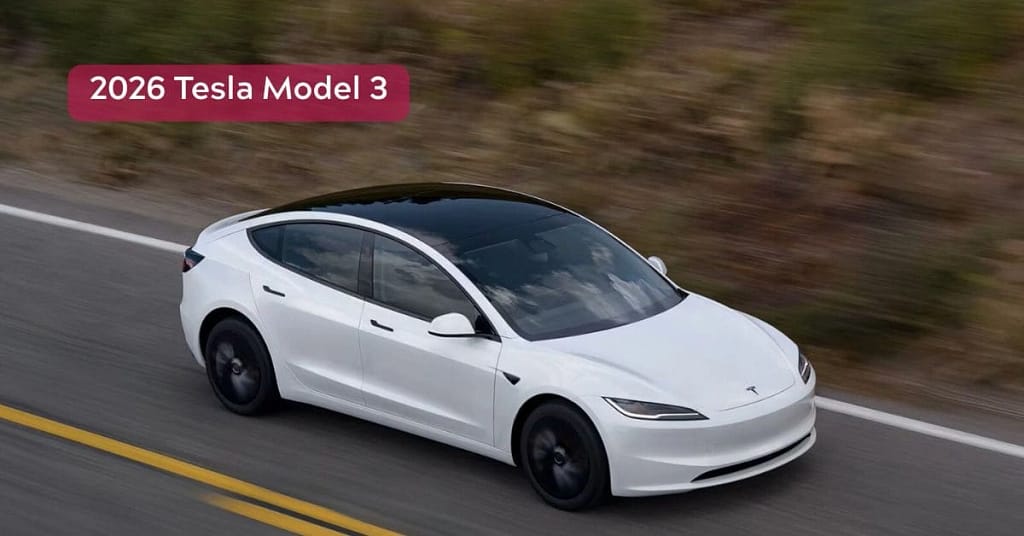
The 2026 Tesla Model 3 doesn’t try to reinvent what made it successful. Instead, it sticks closely to what it already excels over the years—strong efficiency, quick acceleration and a software-first driving experience—while making small adjustments around comfort, trims, and refinement.
Even as competition in the compact and midsize electric sedan space has grown, the Model 3 remains one of the more balanced EVs in terms of range, performance and charging convenience. That said, its minimalist interior layout and reliance on touchscreen controls continue to divide buyers, making it a car that clearly suits some drivers better than others.
At its core, the 2026 Model 3 is less about novelty and more about refinement—making it a better fit for practical EV buyers than early adopters.
What’s New for 2026
The 2026 Tesla Model 3 comes with slight incremental updates rather than major mechanical changes The biggest shift is the return of the Standard trim as the new entry-level option.
Tesla has also updated trim naming across the range. The former Long Range rear-wheel-drive and all-wheel-drive versions are now called Premium RWD and Premium AWD, while the Performance model continues unchanged.
Most other updates focus on refinement. Inside, minor material updates and additional insulation aim to reduce road and wind noise.
Trims and Pricing
Based on official data, the 2026 Tesla Model 3 is offered in four trims.
Trim lineup
Standard – Entry-level version with reduced comfort and technology features
Premium RWD – Single-motor setup focused on longer driving range
Premium AWD – Dual-motor configuration with improved traction and quicker acceleration, but slightly less range
Performance – Highest output model, prioritizing acceleration and handling
Trim Pricing
| Trim | Starting MSRP |
| Standard (RWD) | $36,990 |
| Premium RWD | $42,490 |
| Premium AWD | $47,490 |
| Performance AWD | $54,990 |
Which Trim Makes the Most Sense
For most buyers, the Premium RWD version of the Tesla Model 3 is the most balanced choice. It offers the longest EPA-estimated range in the lineup, retains most comfort and tech features and avoids the compromises found on the entry-level Standard trim.
The Standard model suits buyers focused mainly on price, offering the lowest-cost entry into the Model 3 range. That being said, fewer features and a shorter range make it less convincing if you’re looking for a one-car, long-term solution
The Performance version would make sense if acceleration is the priority, but it gives up some efficiency and day-to-day practicality.
If maximum performance or lowest upfront cost is the priority, the Premium RWD is the one to go for.
Powertrain and Performance
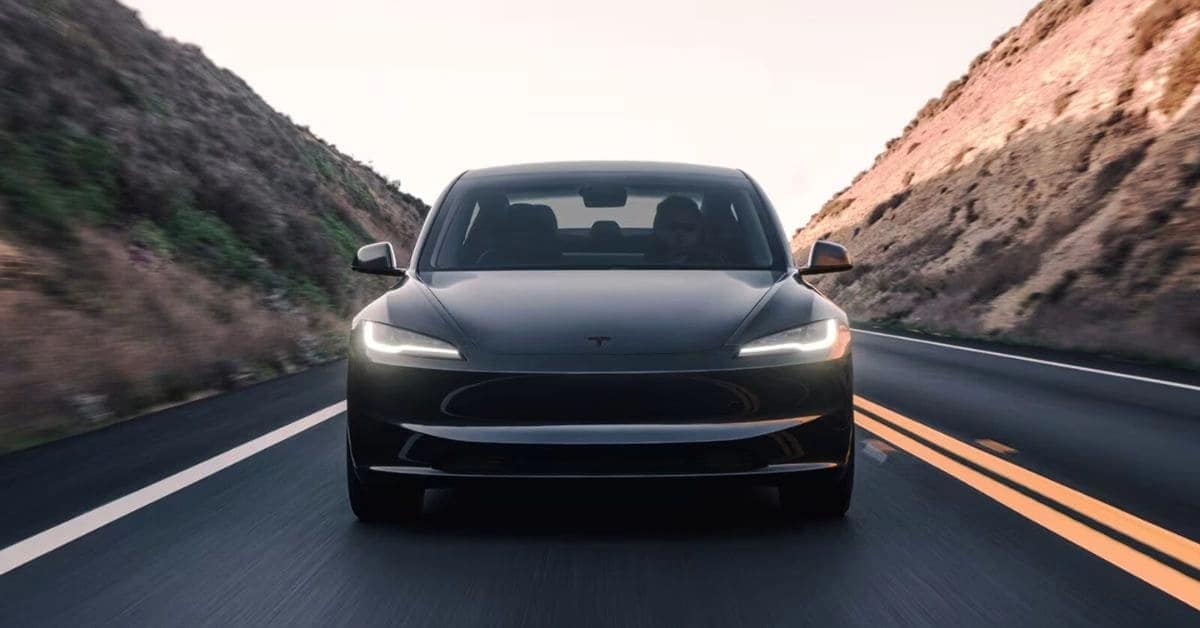
The 2026 Tesla Model 3 is offered with three electric powertrain options, all using an under-floor battery layout. This configuration lowers the center of gravity and supports stable, predictable handling based on vehicle design rather than driving impressions.
Available configurations:
Single-motor RWD – approximately 286 hp
Dual-motor AWD – approximately 425 hp
Dual-motor Performance AWD – approximately 510 hp
Across the lineup, third-party reporting describes power delivery as immediate and smooth, with minimal drivetrain noise and strong mid-range response.
Acceleration
Independent testing published by Car and Driver shows a clear performance spread:
Performance AWD: 0–60 mph in 2.8 seconds
Premium RWD: 0–60 mph in 4.6 seconds
These results place the Performance model in sports-sedan territory. For context, the BMW i4 M50 reaches 60 mph more slowly while carrying a higher starting price, based on published data.
Performance Character
Most Model 3 variants prioritize accessible performance rather than aggressive tuning. Reviews commonly note:
- Strong low- and mid-range acceleration
- Linear, predictable power delivery
- A composed feel at highway speeds
Outside of the Performance trim, the Model 3 is tuned more for efficiency and everyday driving than for outright speed.
Efficiency, Range, and Charging
Based on EPA estimates, the 2026 Tesla Model 3 offers a wide range of driving distances depending on trim and drivetrain configuration.
- Estimated EPA range: 298–363 miles
- Estimated combined efficiency: 109–137 MPGe, depending on version
Real-World Range
Independent highway testing suggests real-world range can fall short of EPA figures, especially at sustained highway speeds and in performance-focused trims:
- Single-motor RWD: approximately 310 miles
- Performance AWD: approximately 260 miles
These results show that while the Model 3 remains efficient compared with most electric sedans, higher speeds and dual-motor setups can noticeably reduce usable range.
Charging and Daily Use
Rear-wheel-drive versions tend to deliver the best real-world efficiency, while dual-motor trims trade some range for added traction and quicker acceleration.
Charging remains a strong point overall, with support for home AC charging and access to Tesla’s Supercharger network, which generally makes long-distance travel easier than relying solely on third-party fast chargers.
Reports also suggest that Long Range versions can still exceed 300 miles of usable range in typical cold-weather driving, though winter conditions naturally reduce efficiency.
Interior Overview
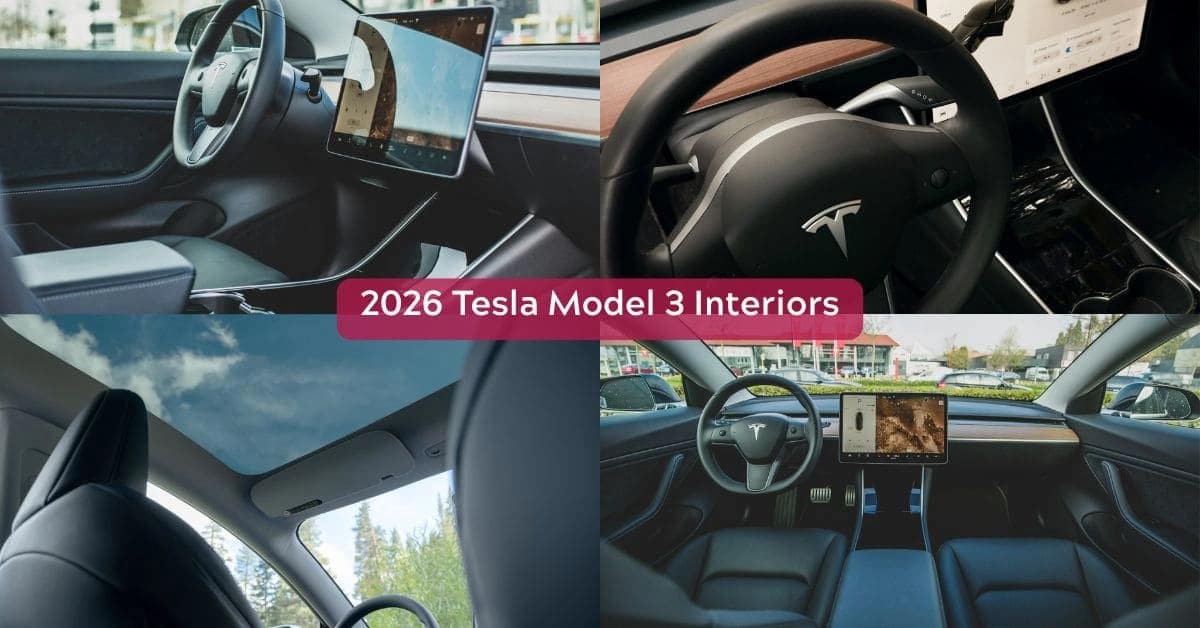
Nearly all functions in the 2026 Tesla Model 3 are handled through a 15.4-inch central touchscreen, with no traditional instrument cluster and very few physical buttons. The design looks clean, but it can require more attention for simple adjustments than cabins with dedicated controls.
Interior highlights:
- Climate settings, mirrors, and most functions are accessed through on-screen menus
- The indicator stalk returns for 2026, replacing the earlier steering-wheel buttons
- Improved materials and added insulation help reduce road and wind noise
- Storage is practical for a sedan, and the fixed panoramic glass roof keeps the cabin bright
Passenger and Cargo Space
The 2026 Tesla Model 3 is a five-seat sedan that prioritizes front-seat comfort over rear-seat space.
Passenger and cargo highlights:
- Front seats offer good headroom, legroom, and standard power adjustment, with solid visibility for a low-slung EV
- Rear-seat space is more limited, with reduced headroom and legroom for taller passengers due to the low seating position and sloping roofline
- An available 8.0-inch rear touchscreen adds convenience but doesn’t improve overall space
- Cargo room is strong for the segment, with a usable rear trunk and a small front trunk for charging gear or small items
- Folding rear seats and under-floor storage add flexibility, though overall capacity trails crossover-style EVs
Specifications
| Category | Specification |
| Vehicle Type | Compact electric sedan |
| Powertrain | Battery electric |
| Drivetrain Options | Rear-wheel drive (RWD), All-wheel drive (AWD) |
| Motor Configurations | Single-motor (RWD) Dual-motor (AWD) |
| Power Output (reported) | ~286 hp (Single Motor RWD) ~425 hp (Dual Motor AWD) ~510 hp (Performance AWD) |
| Battery Type | Lithium-ion (chemistry not officially specified by Tesla) |
| 0–60 mph (Car and Driver testing) | 4.6 sec (Premium RWD) 2.8 sec (Performance AWD) |
| EPA-Estimated Range | 298–363 miles (by trim) |
| Car and Driver Highway Range Test | ~310 miles (Single Motor RWD) ~260 miles (Performance AWD) |
| MPGe efficiency figures | Up to ~137 MPGe combined (RWD) ~109 MPGe combined (Performance AWD) |
| DC Fast-Charging (Peak) | Up to 250 kW (Premium & Performance) ~225 kW (Standard trim) |
| Charging Time (DC Fast Charge) | ~10–90% in ~39 minutes (Performance, C/D test) |
| AC Charging | Level 2 home charging supported |
| Infotainment Display | 15.4-inch center-mounted touchscreen |
| Rear Passenger Display | 8.0-inch touchscreen (Premium & Performance trims) |
| Audio System | 9-speaker system (Standard / Premium RWD) 17-speaker premium audio (Performance) |
| Apple CarPlay / Android Auto | Not available |
| Connectivity | Bluetooth, USB connectivity, native navigation, streaming apps |
| Seating Capacity | 5 passengers |
| Cargo Capacity | ~21 cubic feet (combined front and rear storage) |
| Interior Layout | Touchscreen-based controls, no traditional gauge cluster |
| Standard Driver-Assistance | Adaptive cruise control, lane-keeping assist, automatic emergency braking |
Safety and Driver-Assistance Features
The 2026 Tesla Model 3 comes standard with a broad set of driver-assistance and safety features aimed at making everyday driving easier and more predictable. These systems are designed to assist the driver, not replace them, and still require active supervision.
Standard safety features include:
- Adaptive cruise control
- Automatic emergency braking
- Lane-departure warning and lane-keeping assistance
Additional driver-assistance features are available to support highway driving and lane changes, but they are intended for supervised use rather than hands-off driving.
Crash-test ratings for the Model 3 are published by independent safety organizations such as the National Highway Traffic Safety Administration (NHTSA) and the Insurance Institute for Highway Safety (IIHS), allowing buyers to compare its safety performance with other electric sedans.
Pros and Cons
Pros
- Quick acceleration for the price, especially in higher trims
- Strong efficiency and competitive EPA-estimated range on select versions
- Smooth and responsive electric power delivery
- Improved ride comfort and reduced cabin noise compared with earlier models
- Well-integrated software and access to Tesla’s Supercharger network
Cons
- Heavy reliance on touchscreen controls for basic functions, including gear selection
- No Apple CarPlay or Android Auto support
- Real-world highway range can fall short of EPA estimates
- Rear-seat space is limited compared with SUV-style alternatives
- Minimal physical buttons may frustrate drivers who prefer traditional controls
Key Limitations & Trade-Offs
- The minimalist interior design reduces visual clutter but places heavy reliance on touchscreen menus for everyday functions
- Buyers trade physical controls for a software-driven interface that may feel less intuitive to some drivers
- Entry-level pricing comes with noticeable feature reductions compared with higher trims
- Rear-seat comfort and overall versatility are limited by the sedan body style, especially when compared with crossover alternatives
- Optional upgrades and higher trims can push pricing up quickly, narrowing the value gap versus competitors
How the 2026 Tesla Model 3 Compares to Rivals
The Tesla Model 3 faces more competition than ever in the compact and midsize electric sedan space. Alternatives like the BMW i4 and Polestar 2 offer more traditional interiors, higher-end materials, and physical controls, which may appeal to buyers who find Tesla’s minimalist approach too extreme. The trade-off is price, as those models typically cost more when similarly equipped and rely more on third-party charging networks.
Against crossover-style EVs such as the Tesla Model Y or Hyundai Ioniq 5, the Model 3 gives up rear-seat space and cargo flexibility in favor of better efficiency, a lower starting price, and a more sedan-like driving feel.
Overall, the Model 3 continues to offer a well-rounded mix of efficiency, performance, and everyday usability. While rivals may excel in specific areas, few combine range, performance, and fast-charging convenience as effectively at this price point.
Who Should Buy
- Buyers looking for strong electric performance and efficiency relative to price
- Drivers who are comfortable with a software-first, touchscreen-based control layout
- Owners who plan to make regular use of fast-charging infrastructure, including Tesla’s Supercharger network
- Those who prefer a sedan driving experience over a taller SUV or crossover
Who Should Skip
- Drivers who prefer physical buttons, gauges, and traditional control layouts for core functions
- Buyers who need generous rear-seat space or regularly carry taller passengers
- Shoppers set on a crossover or SUV body style for added versatility
- Those who strongly prefer Apple CarPlay or Android Auto integration
Verdict
The 2026 Tesla Model 3 remains a solid option in the electric sedan segment, not because it has changed dramatically, but it continues to offer a strong balance of efficiency, quick acceleration, and charging convenience that many rivals struggle to match at similar prices.
That balance does come with trade-offs. The software-first interior and heavy reliance on touchscreen controls won’t suit everyone, and real-world highway range—especially in performance-oriented trims—can fall short of EPA expectations.
For buyers who value efficiency, responsive performance, and easy access to fast charging, the Model 3 is still a compelling choice. Those who want more interior space, traditional controls, or SUV-like versatility may be better served elsewhere.
ALSO READ – 2026 Volvo XC40 Review – What’s New, Specs, and Pricing
Frequently Asked Questions (FAQs)

I’m Brandon Coldwell, and I write about the latest car launches, EVs, and trends shaping the automotive world. I’ve always loved cars — the design, the tech, and the excitement of new releases — and now I enjoy turning updates into clear, helpful posts.