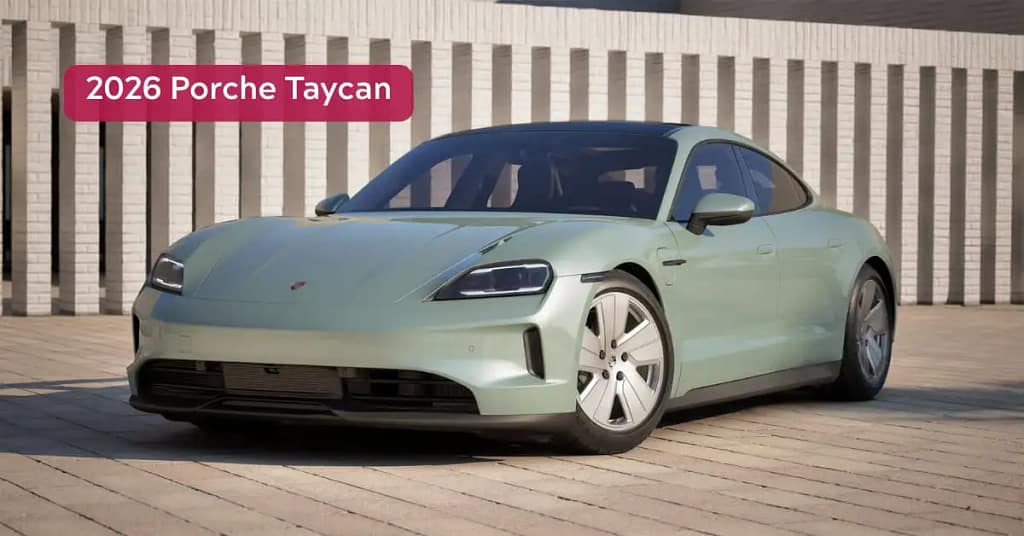
The 2026Porsche Taycan prioritizes performance and design over range and space, offering strong acceleration but less rear-seat room, cargo space, and driving range than some rivals.
The trim lineup ranges widely in power and price, with the 4S and GTS delivering the best balance, while higher trims add performance at a steep cost and lower efficiency.
The Taycan suits buyers who value Porsche engineering and customization more than maximum range, practicality, or value for money.
Table of Contents
Overview
The 2026 Porsche Taycan remains Porsche’s first fully electric four-door sedan, continuing the same Taycan generation that launched in 2020. For 2026, the Taycan targets buyers looking for a high-end electric car that still follows Porsche’s traditional focus on design and performance.
The lineup is wide with different power levels, drivetrains and body styles including sedan and wagon versions. Trims like the Taycan GTS sit above the standard Taycan and Taycan 4, focusing more on performance than entry-level pricing.
What’s New for 2026
For 2026, the Porsche Taycan receives small updates instead of a full redesign. Most of the changes focus on technology and features, including:
A faster infotainment system with updated hardware
A built-in app center for downloading apps
Expanded voice control, including Amazon Alexa
Dolby Atmos support for the optional Bose and Burmester sound systems
New Black Edition trims for the Taycan, Taycan 4, and Taycan 4S, with blacked-out interior and exterior details
Trims and Prices
Trim
Starting MSRP (USD)
Taycan (RWD)
$106,150
Taycan 4
$110,250
Taycan 4S
$125,950
Taycan GTS
$156,450
Taycan Turbo
$183,550
Taycan Turbo S
$219,750
Taycan Turbo GT
$241,650
Which Trim Makes the Most Sense
For most buyers, the Taycan 4S offers the best balance. It comes with all-wheel drive and strong performance but costs less than the Turbo models.
The Taycan GTS is a good choice for buyers who want more power and performance-focused features without paying Turbo-level prices. It sits nicely between the 4S and the higher-end trims.
The Turbo and Turbo GT trims are best for buyers who want the most power and don’t mind the high price. Buyers who care more about value or efficiency may find the lower trims a better fit.
Engine and Performance
The 2026 Taycan comes with different electric motor setups depending on the trim.
Base models use a single motor that powers the rear wheels, while most higher trims use two motors with all-wheel drive. Power ranges widely, from about 402 horsepower in lower trims to up to 1,019 horsepower in the Turbo GT.
The Taycan GTS sits in the middle of the lineup. It uses a dual-motor all-wheel-drive system and is rated at around 690 horsepower and 582 lb-ft of torque. Like other Taycan models, it uses a two-speed transmission to support both quick acceleration and steady highway driving.
Independent testing published by Car and Driver shows that higher-trim Taycan models deliver very strong acceleration under controlled conditions. Actual results can vary, but the Taycan is clearly positioned as a performance-focused electric sedan.
Range and Efficiency
Range and efficiency for the 2026 Taycan depend on the trim, battery choice, and wheel size. Based on EPA data from recent model years, most Taycan versions are rated for about 252 to 318 miles of driving range.
Higher-performance trims, including the Taycan GTS, usually fall toward the lower end of that range. Past industry data has placed the GTS in the high-200-mile range, while trims like the Taycan 4S tend to deliver better efficiency. Turbo models usually have the shortest range because of their higher power and added weight.
Final, trim-specific range and efficiency ratings are published by the Environmental Protection Agency (EPA). Buyers should expect a clear trade-off: more performance generally means less driving range.
Interior Overview
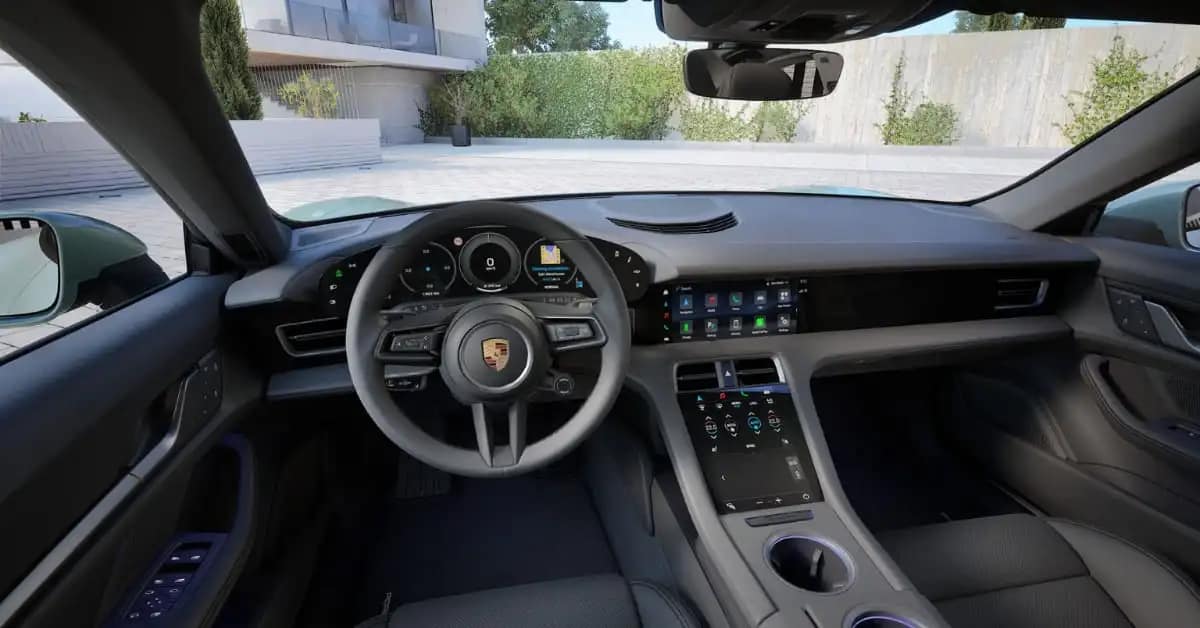
The Taycan’s interior style and design is clean and practical, with most controls handled through screens instead of physical buttons.
Interior design highlights include:
A multi-screen dashboard layout
Fewer physical buttons than traditional luxury sedans
A layout focused on the driver rather than decoration
Customization and materials vary by trim:
Leather and Race-Tex upholstery on higher trims
Carbon fiber trim and contrast stitching
GTS-specific accents on Taycan GTS models
Optional comfort features can include:
Massaging front seats
Four-zone climate control
Heated rear seats
Compared with some luxury EV rivals, the Taycan feels more sport-focused than lounge-like. This suits buyers who care more about a purposeful layout and material quality than extra space or flashy interior design.
Image Source – Porche
Passenger and Cargo Space
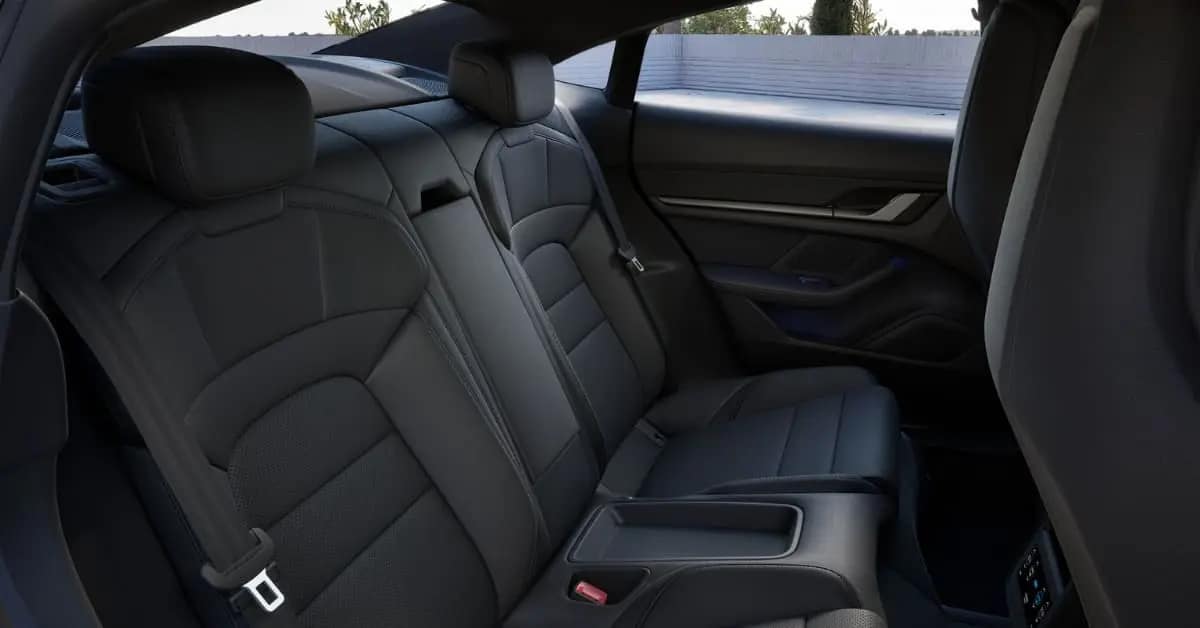
Passenger space in the Taycan is more limited than in many other electric sedans. This is mostly due to its low roof and sporty shape. The Taycan’s low roof and compact rear seating can be less accommodating for taller passengers. Most versions come with four seats, though a fifth rear seat is available on some trims.
Cargo space is also fairly small. The rear trunk holds about 12–14 cubic feet, depending on the setup, and there is a small front trunk often used for charging cables or small items. Sedan models use a standard trunk instead of a hatchback, which makes carrying large items more difficult.
Buyers who need more room may want to consider the Cross Turismo or Sport Turismo versions, which offer more cargo space while using the same basic platform.
Image Source – Porhce
Infotainment and Technology
The Taycan uses a screen-heavy infotainment layout, with most functions handled through touch controls rather than physical buttons. For 2026, the system benefits from updated hardware that improves response times.
Key infotainment and technology features include:
10.9-inch central touchscreen for infotainment and core vehicle functions
16.8-inch curved digital instrument cluster ahead of the driver
8.4-inch lower touchscreen for climate and vehicle settings
Wireless Apple CarPlay and Android Auto
Wireless phone charging
Navigation with charging-station integration
Optional technology features include:
Front passenger display
Rear-seat touchscreen for climate and seat controls
Bose or Burmester audio systems, now with Dolby Atmos support
Safety & Driver-Assistance Features
The Taycan includes a solid set of standard safety features, with more advanced driver aids offered as options.
Standard features typically include:
Automatic emergency braking, including pedestrian detection
Lane-departure warning with lane-keeping assist
Blind-spot monitoring
Available options can include:
Adaptive cruise control with lane-centering
360-degree camera system
Crash-test ratings and safety evaluations are published by the National Highway Traffic Safety Administration (NHTSA) and the Insurance Institute for Highway Safety (IIHS). Final scores can vary by trim and testing updates, so it’s worth checking the latest results when comparing safety performance.
Pros and Cons
Pros
Strong electric performance across the lineup, including dual-motor AWD options
Fast DC charging capability compared with many luxury EV rivals
Wide range of trims, power levels, and customization options
High build quality and a distinctive Porsche design inside and out
Cons
Pricing rises quickly once options are added
Electric range trails some long-range competitors
Rear-seat space and cargo flexibility are more limited than key rivals
Heavy reliance on touchscreen controls may not suit all buyers
Key Limitations & Trade-Offs
The Taycan is built around Porsche’s performance-first priorities and that focus comes with clear compromises. Interior space and cargo flexibility are limited by its low-slung proportions, and electric range does not lead the segment compared with efficiency-focused rivals like Tesla Model S.
Many of the Taycan’s tech and customization features aren’t standard, so the price can climb quickly once options are added. The cabin also relies heavily on touchscreen controls, with fewer physical buttons than some buyers may prefer.
Overall, these trade-offs reflect how the Porsche Taycan is positioned: it makes more sense for buyers who value performance, design and brand identity over maximum range, space, or value pricing.
Specifications
Category
Details
Powertrain
Battery-electric
Motor Configuration
Single motor (RWD) or dual motors (AWD), trim dependent
Power Output
Approximately 402 hp to 1,019 hp, depending on trim
Taycan GTS Output
~690 hp / ~582 lb-ft of torque
Battery Options
Standard battery or Performance Battery Plus (approx. 105 kWh, where equipped)
Drivetrain
Rear-wheel drive or all-wheel drive
Transmission
Two-speed gearbox (rear axle)
EPA-Estimated Range
Roughly 252–292 miles, depending on trim and configuration
Charging (DC Fast Charge)
Approx. 10–80% in ~18 minutes under ideal conditions (reported)
Cargo Capacity
About 12–14 cubic feet (rear trunk), plus front trunk
Body Styles
Sedan, Cross Turismo, Sport Turismo
Warranty (Basic)
4 years / 50,000 miles
Warranty (Battery / Powertrain)
8 years / 100,000 miles
How the Taycan Compares to Key Rivals
Porsche Taycan prioritizes performance consistency, chassis tuning, and customization over outright range or cabin space.
Tesla Model S focuses more on long driving range and straight-line acceleration, making it a better fit for frequent long-distance driving.
Lucid Air emphasizes efficiency and interior space, offering some of the longest range figures in the segment.
Mercedes-Benz EQS and BMW i7 lean toward rear-seat comfort, ride isolation, and a more traditional luxury experience.
Who Is It For
The Taycan makes the most sense for those who care more about performance-oriented engineering and design than maximizing range, space or value.
Who Should Skip
The Taycan may not be the right choice for buyers who prioritize maximum electric range, generous rear-seat space or large cargo capacity. It’s also less appealing for shoppers who want extensive physical controls or are focused primarily on value, efficiency, or getting the most features for the lowest price.
Those who regularly carry rear passengers or want a more practical, long-distance electric sedan may find better options elsewhere in the segment.
Verdict
The Porsche Taycan stands out in the luxury EV market for 2026, not because of range or price, but because of its focus on performance and design. It isn’t the most practical or longest-range electric sedan. Instead, it’s built for buyers who care more about how the car is engineered and laid out than getting the most space or value.
For buyers who want an electric sedan built around performance instead of just tech, the Taycan can be a good fit. Trims like the 4S and GTS offer a better balance of power and price than the base or top-end models. The downsides are clear: options raise the price quickly, rear-seat and cargo space are limited, and driving range is lower than some competitors.
In short, the Taycan is a luxury electric car focused on performance, not an all-around EV. Buyers who are okay with that focus will see its value, while those who want more range, space, or value may be happier with other options.
FAQs
Is the 2026 Porsche Taycan a new generation?
No. The 2026 Taycan remains part of the original Taycan generation introduced in 2020. Updates for this model year focus on technology and features rather than a full redesign or new platform.
Which Taycan trim offers the best balance?
For many buyers, the Taycan 4S or Taycan GTS offers the most balanced mix of performance and price. The 4S provides strong output with all-wheel drive at a lower cost than Turbo models, while the GTS adds more performance-focused hardware without reaching top-tier pricing.
How does the Taycan compare on range versus rivals?
The Taycan generally delivers less range than long-range-focused competitors like the Tesla Model S or Lucid Air. Higher-performance trims sit toward the lower end of the range spectrum, reflecting Porsche’s emphasis on performance over efficiency leadership.
Does the Taycan rely heavily on touchscreens?
Yes. Most vehicle functions, including climate controls, are managed through touchscreens rather than physical buttons. Buyers coming from more traditional interiors may need some adjustment.
I’m Brandon Coldwell, and I write about the latest car launches, EVs, and trends shaping the automotive world. I’ve always loved cars — the design, the tech, and the excitement of new releases — and now I enjoy turning updates into clear, helpful posts.